
If you’ve spent any time researching how to launch an online clothing boutique, you’ve probably fallen down the Shopify vs WooCommerce rabbit hole, and come out more confused than when you started. Because here’s the thing — most of the advice out there is generic, and not written for someone who wants to start an online boutique. Plus, most WooCommerce vs Shopify comparisons miss the most important part of this decision entirely.
That’s what this post is for. I won’t give you a feature-by-feature spec sheet, but a practical look at each platform and a framework to make an informed decision.
Spoiler alert: both platforms work for online clothing shops. The choice depends on where you are in your business right now, not just which one has more features.
What you’re actually choosing between
Framing the choice as WooCommerce vs Shopify is missing the elephant in the room – Etsy. So let’s look properly at your options, and compare all three.
Shopify is a hosted store platform. You pay a monthly subscription that covers hosting, security, updates, and checkout. You build your own store, drive your own traffic. Crucially, you pay a monthly subscription regardless of whether you make any sales.
WooCommerce is a free plugin that turns a WordPress website into a full online store. You own the site, choose your own hosting, control every aspect of how it looks and functions. Instead of monthly subscription, you’ll be paying for hosting and domain at a minimum.
Etsy is a marketplace. You’re not building a store — you’re setting up a stall inside someone else’s market. Etsy brings the buyers, you bring the products. You pay per listing and per sale, with no monthly subscription.
The key difference between Etsy and the other two is this:
Etsy is incentivised to bring buyers to you, because that’s how they make their money. Shopify and WooCommerce make money whether you make any sales or not.
What each platform actually costs
Etsy
Etsy charges $0.20 per listing (renewed every 4 months), a 6.5% transaction fee on every sale, and payment processing on top. When you add it all up, Etsy takes roughly 10% of every sale. No monthly subscription, so there’s no cost if you make no sales.
For a boutique doing $500/month in sales, Etsy fees run roughly $50–$55/month.
Shopify
The Basic plan is $39/month on monthly billing, or $29/month if you commit to annual billing. Every sale through Shopify Payments costs 2.9% + 30¢ in transaction fees (it goes down on higher-tier plans). If you use a third-party gateway instead of Shopify Payments, Shopify adds an extra 2% on top of that.
Where costs compound is the app store. Shopify’s core plan doesn’t include things like size guides, product reviews, email marketing, or a returns portal — those all require third-party apps, most of which charge monthly. Here’s what the most common ones cost:
| App | What it does | Cost |
|---|---|---|
| Kiwi Size Chart | Size guides on product pages | Free plan; from $9.99/month |
| Judge.me | Customer reviews with photos | Free plan; from ~$15/month |
| Klaviyo | Email marketing and automation | Free to 250 contacts; from $20/month |
| Loox | Photo reviews and social proof | From $9.99/month |
| Smile.io | Loyalty and rewards program | Free plan; from $49/month |
| ShipStation | Shipping labels and management | From $9.99/month |
| Loop Returns | Returns management portal | From $29/month |
You don’t need all of these at launch, but a modest setup — base plan, size charts, reviews, and email marketing — typically runs $70–$90/month. That’s $840–$1,080 per year, before a premium theme. Think carefully which add-ons you might want immediately vs later for accurate cost calculation.
Speaking of which: premium Shopify themes run $150–$420 as a one-off. That’s a significant addition to year-one costs, although you could start with a free theme and invest in a paid theme later.
WooCommerce
WooCommerce is a free plugin, so there is no platform fee, but you will be paying for hosting. Running a WooCommerce store typically includes:
- hosting ($2–$10/month depending on your plan),
- payment processing (2.9% + 30¢ per transaction through Stripe),
- a premium theme (optional). This can run you anywhere from around $39–$120,
- extensions (equivalent of Shopify’s apps).
Just like with Shopify, the extra plugins (aka extensions) is where costs can start to add up. Generally though WooCommerce tends to have more options with a free plan.
Here’s how the two stacks compare side by side:
| Function | Shopify app | Cost | WooCommerce equivalent | Cost |
|---|---|---|---|---|
| Size guides | Kiwi Size Chart | From $9.99/month | WPC Product Size Chart | Free |
| Customer reviews | Judge.me / Loox | From $9.99–$15/month | Customer Reviews for WooCommerce (CusRev) | Free; PRO version $7.99/ month |
| Email marketing | Klaviyo | From $20/month | MailPoet | Free to 500 subscribers; from $10/month |
| Shipping labels | ShipStation | From $9.99/month | Shippo | Free (pay per label) |
| Returns | Loop Returns | From $29/month | Flexible Refund and Return Order for WooCommerce | Free |
For most small boutiques, the WooCommerce plugin stack costs nothing at launch. The Shopify equivalent runs $30–$50/month.
Beyond cost — what else matters for a clothing boutique
Brand control. Etsy gives you almost none. You can add a banner to your storefront, but generally every shop looks the same. Shopify gives you a curated selection of well-made themes. WooCommerce gives you thousands of themes across every aesthetic — boho, coastal, editorial, minimal, quiet luxury. If you ever want to customise beyond the theme, you can do it in the block editor yourself, or hire any WordPress developer (and there’s a huge market for these services). Shopify customisation beyond the theme editor requires someone who knows their proprietary system specifically, which tends to be a more specialised and more expensive service.
Traffic. Etsy brings buyers to you. Shopify and WooCommerce don’t — you’re responsible for driving your own traffic through SEO, social, and marketing. This is the trade-off most people underestimate when leaving Etsy.
SEO and content. WordPress is built around content, so if blogging and organic search are part of your plan, WooCommerce is the better foundation. Shopify has a blog feature, but it was bolted on. WordPress was built for this from the start.
Customer ownership. On Etsy, the customer belongs to Etsy. You can’t email them directly or build a relationship outside the platform. On Shopify and WooCommerce you won the customer relationship.
What’s the catch?
Etsy. As your sales grow, the 10% fee per sale compounds (and stings!) quickly. At $2,000/month in sales, Etsy is taking roughly $200. Etsy also controls your rankings, your visibility, and your customer relationships — and can change the rules at any time.
Shopify. You pay $39/month from day one, whether you make any sales or not. With some basic apps on top, it’s closer to $80-$100 /month. And if you ever want to move to WooCommerce later, the migration is painful — products, customer records, and SEO don’t transfer cleanly.
WooCommerce. The setup has more steps. You choose hosting, install WordPress, install WooCommerce, choose a theme, and configure things yourself — there’s no single guided wizard. For someone new to WordPress, the first setup takes a few hours and some patience. Ongoing maintenance (plugin updates, backups) is also on you, though most good hosts handle a lot of this automatically.
How to decide
The way most people approach this decision is “which platform is better?” — and that’s the wrong question to ask. The more useful question is: Have you already made any sales?
Here’s how to find your platform:
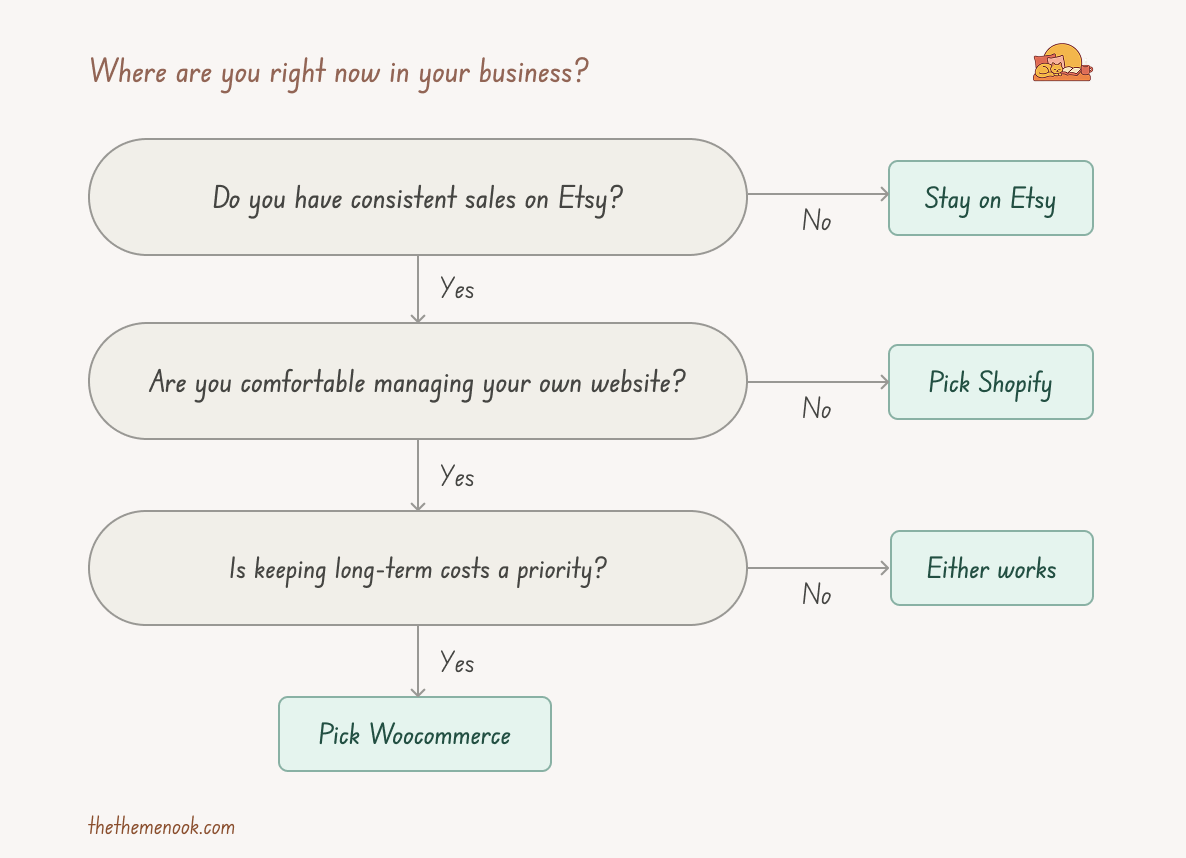
If you’re still validating — you’re not sure yet if people want to buy what you’re selling — stay on Etsy. The pay-per-sale model means no fixed costs while you figure that out. Once you have consistent sales, the 10% fee starts to hurt.
If you have consistent sales and you’re ready to own your platform, that’s when the question is Shopify or WooCommerce? For most clothing boutiques, WooCommerce makes more sense: the plugin stack is free, the theme options are far broader, and the cost savings compound over time. Shopify is a reasonable choice if you want to avoid WordPress setup entirely and the higher monthly cost isn’t a concern — but go in knowing that switching platforms later is painful, so start where you intend to stay.
If you’re ready to make the move from Etsy, this post walks through the signs you’re ready. And if you’ve decided on WordPress, this guide covers the full setup process step by step.
FAQ
Is Shopify or WooCommerce better for a clothing boutique?
Shopify is faster to set up and easier to get started with. WooCommerce costs significantly less to run, gives you more theme options and flexibility as your brand grows, and works better for content-driven traffic. Most boutique owners thinking long-term end up on WooCommerce. If you want to launch fast and cost isn’t your main concern yet, Shopify gets you there quicker.
Should I use Etsy, Shopify, or WooCommerce for my boutique?
It depends on where you are in your business. Etsy is the right place to validate whether people want to buy what you’re selling. With no monthly fees, built-in traffic, and payment only when you make a sale it’s hard to beat. Once you have consistent sales and you’re ready to build a brand, WooCommerce is the strongest long-term option. Shopify sits in the middle — lower setup friction than WooCommerce, but higher ongoing costs than both Etsy and WooCommerce.
How much does Shopify cost compared to WooCommerce for a boutique?
Shopify’s Basic plan is $39/month (or $29/month on annual billing), plus 2.9% + 30¢ on every transaction through Shopify Payments. Add the apps most boutiques need and you’re typically at $70–$90/month — so $840–$1,080 per year before a premium theme ($150–$420 one-off). WooCommerce itself is free, most equivalent functionality is covered by plugins that offer a free tier, and your main costs are hosting ($2–$10/month), domain, and optionally a theme ($39–$120 one-off). Year-one costs for a WooCommerce boutique are typically well under $300.
Can I run Etsy and WooCommerce at the same time?
Yes, and many boutique owners do. Running both lets you keep Etsy’s marketplace traffic while building your own store and audience in parallel. You’ll need to manage inventory separately (the two platforms don’t sync automatically), or use an integration plugin.
Does WooCommerce look as professional as Shopify?
Yes, with the right theme. WooCommerce has thousands of themes across every aesthetic, giving you far more choice than Shopify’s curated store. A well-built WooCommerce theme designed for fashion boutiques will look every bit as polished as a Shopify store.
Is it hard to switch from Shopify to WooCommerce later?
It’s doable but involves real work — migrating products, customer records, and setting up URL redirects to protect your SEO takes time and effort. Make the right call upfront rather than planning to switch later.
Which platform is better for SEO — WooCommerce or Shopify?
WooCommerce. It runs on WordPress, which is built around content, and gives you full control over every SEO element with far stronger blogging infrastructure. Shopify has improved its SEO, but content is still an add-on rather than a core feature — and for a boutique planning to grow through organic search, that difference adds up.
Where to go from here
If you’re still on Etsy and weighing up whether to make the move, this post walks through the signs you’re ready.
If you’ve decided on WordPress and want to understand the full setup process, this guide walks through it step by step.
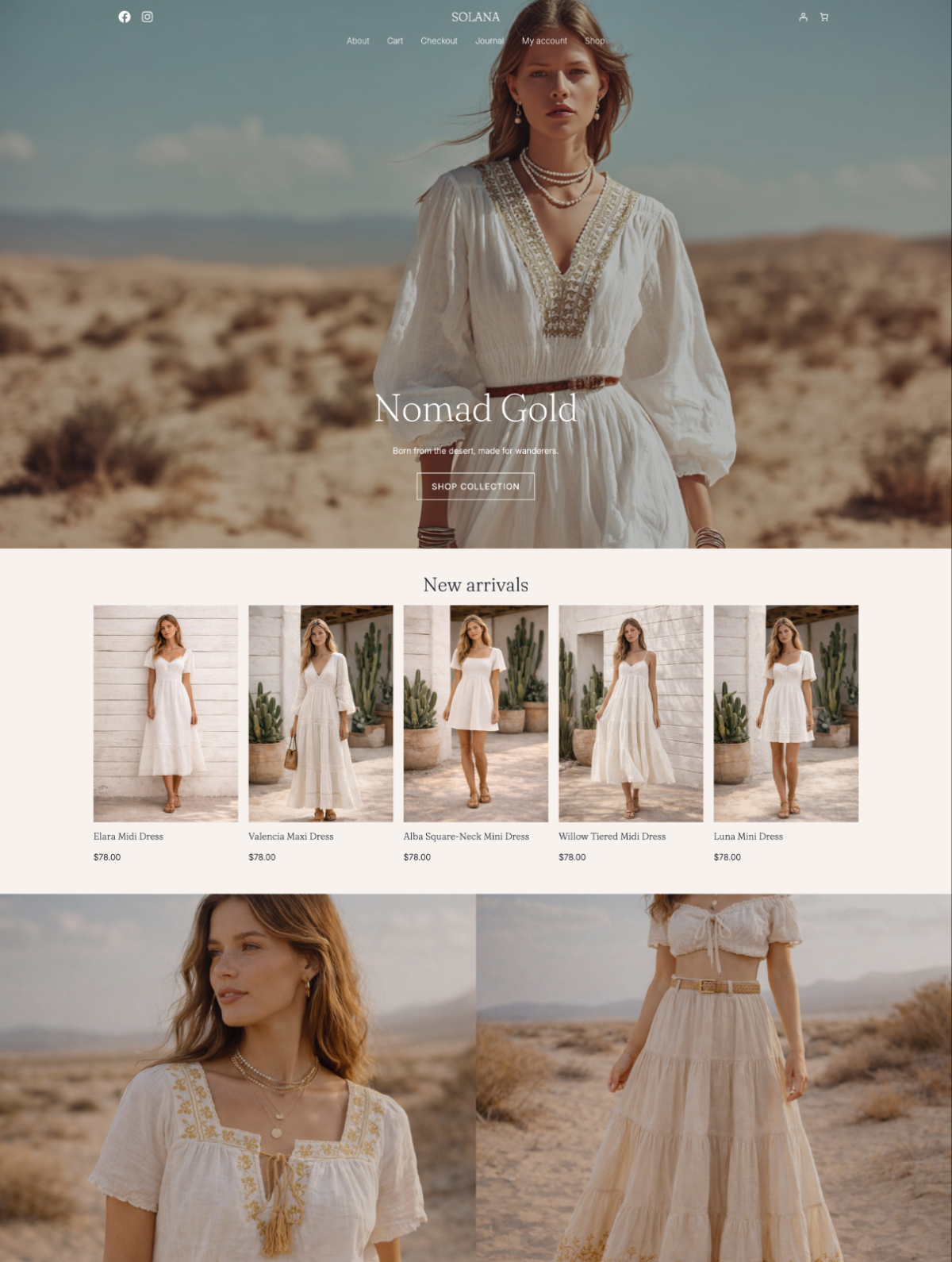
When you’re ready to look at themes built specifically for clothing boutiques, browse The Theme Nook’s WooCommerce themes →



Comments
One response to “WooCommerce vs Shopify for a Clothing Boutique: Which One Is Right for You?”
Great breakdown! It’s so easy to get lost in the feature comparisons, but I love how you’ve made it clear that the decision should depend more on where you’re at with your business. Etsy as an option is a great point, too!